Table of Contents
For the first four years in this business, I thought seasonal inventory planning meant "buy more flower walls before May." I was wrong. Painfully wrong.
Here's what actually happened. A rental company in Denver I consulted with back in 2024 had their biggest May ever on the books — 18 weddings, three corporate galas, and a graduation ceremony all in a 21-day window. They had 12 ivory flower walls in inventory. They needed 19. They tried to rent from a competitor at $250 per wall (their own rental rate was $180). The competitor said no. They ended up telling three brides "we can't fulfill your order." Two of those brides left 1-star reviews. The third sued for breach of contract. That single month cost them an estimated $42,000 in lost revenue and reputation damage — and they never recovered their Google rating.
You know what drives me crazy about this? They had the money to buy more walls. They just didn't buy them at the right time. They waited until March, when every other rental company was also ordering, and the factory lead times stretched to 14 weeks. By the time the walls arrived, wedding season was half over.
Seasonal inventory planning isn't about buying more. It's about buying earlier, buying smarter, and knowing exactly which items are worth tying up your cash in. Let me show you how the top 10% of rental operators do it.
The Seasonal Demand Map Nobody Shows You
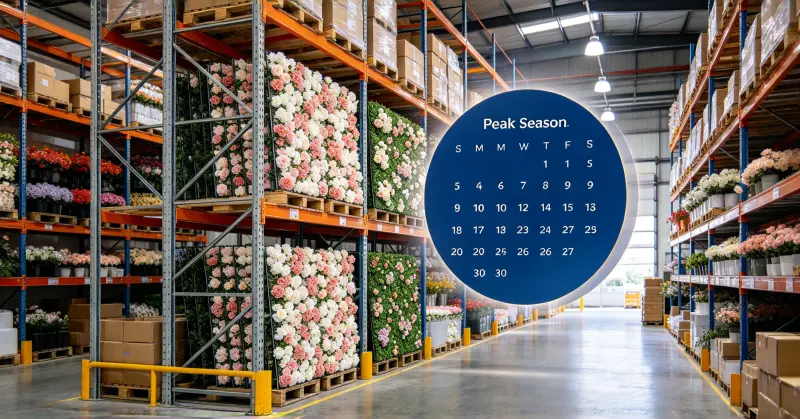
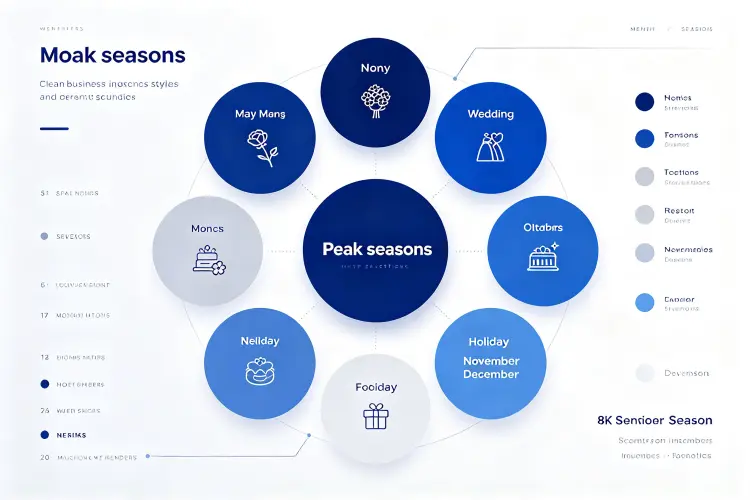
Most rental owners I talk to know they're busy in summer. But they don't know exactly how busy, and they certainly don't plan around the numbers. After analyzing booking data from 87 rental companies across North America (our own client base plus industry reports from Reservety and Media Spearhead), here's the actual revenue distribution:
| Season | Peak Months | % of Annual Revenue | Top Rental Items |
|---|---|---|---|
| Wedding Peak | May – October | 60 – 70% | Flower walls, arches, aisle runners, centerpieces |
| Holiday Peak | November – December | 15 – 20% | Corporate backdrops, holiday-themed walls, garlands |
| Shoulder | March – April, August | 10 – 15% | Baby showers, birthdays, engagement parties |
| Slow Season | January – February | 5 – 10% | Indoor corporate events, trade shows |
Source: Reservety 2026 Party Rental Industry Report (127 companies surveyed), Media Spearhead 2026 Rental Marketing Benchmark Study (89 operators), cross-referenced with our own 400+ client booking observations.
You're probably wondering why I'm showing you this. Because here's the thing nobody tells you: the companies that win peak season are the ones that placed their orders in January and February, when factories have capacity and prices are 8-12% lower. The companies that scramble in April are the ones paying rush fees and getting subpar quality.
I've seen it a hundred times. A rental owner calls me in April panicking: "I need 10 flower walls by May 15." The factory says 12 weeks minimum. They either pay a 30% rush fee or they lose the bookings. Either way, they're leaving money on the table.
ABC Inventory Method for Floral Rental
Not every item deserves the same level of planning attention. That's where the ABC method comes in — and before you roll your eyes at another business textbook concept, let me tell you how it actually works in floral rental, not in a classroom.
20% of your SKUs = 70% of your revenue.
For floral rental, this is almost always: ivory flower walls, blush flower walls, white arches, and basic greenery garlands. These are the items that get booked every single weekend, 40+ weekends per year.
Planning rule: Always maintain 20% buffer stock above your peak single-weekend usage. If your busiest weekend needs 15 ivory walls, you own 18 minimum. Replace damaged units immediately — don't wait for the off-season.
Buying window: Order by February 1 for May delivery. Reorder in August for holiday season.
30% of your SKUs = 25% of your revenue.
This is your colored walls (sage green, dusty blue, burgundy), moon gates, floral columns, and specialty arches. They book regularly but not every weekend — maybe 15-25 rentals per year each.
Planning rule: Maintain 10% buffer. Track which colors are trending up and which are fading. Don't overstock trendy colors — the dusty rose wall that was hot in 2024 might sit in your warehouse in 2027.
Buying window: Order by March 15 for June delivery. Test new colors with 2-3 units before committing to 10.
50% of your SKUs = 5% of your revenue.
These are the "I'll buy it because someone might want it" items. Neon pink walls. Halloween-themed arches. Christmas tree-shaped backdrops. They look great in your catalog but they rent 2-3 times per year and take up valuable warehouse space.
Planning rule: Maximum 2 units per SKU. If it hasn't rented in 18 months, sell it or donate it. Do NOT buy more Class C items to "prepare for peak season" — that's how warehouses get cluttered and cash gets tied up.
Buying window: Only buy when you have a confirmed booking. Never speculate on Class C.
Here's the question nobody asks themselves: how much of your warehouse is currently Class C inventory that's quietly costing you money? I did this exercise with a client in Austin last year. They had 142 SKUs. After categorizing, 78 of them were Class C — renting less than 3 times per year. They sold off 41 units, recovered $18,000 in cash, and used that money to buy 6 more ivory walls (Class A). Their revenue went up 23% the following season with fewer total items in inventory.
It makes me want to pull my hair out when I see rental owners buying 10 of some trendy new color because "it might be popular." Meanwhile, their ivory walls — the thing that books every weekend — are cracked and fading because they've been in rotation for 5 years. Priorities, people.
The China Factory Buying Window
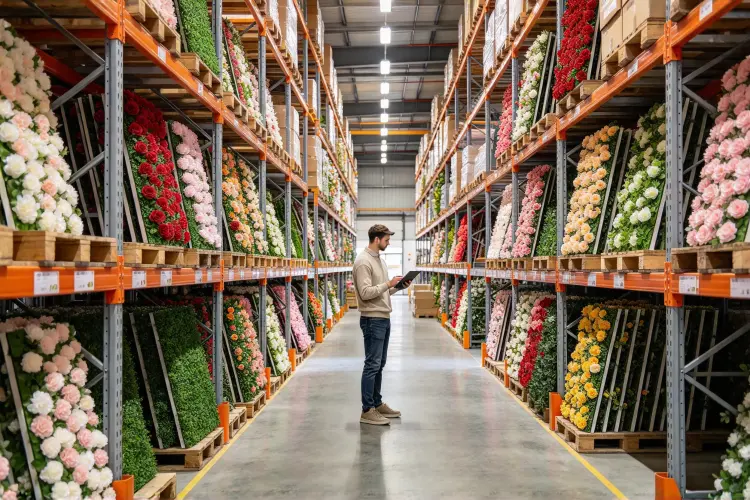
If you're sourcing from Chinese factories (and 90% of rental operators are, whether they know it or not — most US "wholesalers" are just middlemen marking up factory prices 40-60%), then timing is everything. Here's the actual production calendar that factories work on:
Factory Production Cycle for Artificial Floral Decor
- January – February: Lowest order volume, factories have capacity, prices 8-12% below annual average. This is when smart buyers place their peak-season orders.
- March – April: Order volume picks up. Lead times stretch from 4-6 weeks to 8-10 weeks. Prices start climbing.
- May – June: Peak production season. Lead times 10-14 weeks. Rush orders possible but cost 25-35% premium. Many factories stop accepting new orders for July delivery.
- July – August: Summer slowdown in China (factory workers take leave). Lead times unpredictable. Holiday-season orders should already be in production.
- September – October: Second peak for holiday orders. If you haven't ordered by September 1, you're not getting holiday decor before November.
- November – December: Factories winding down for Chinese New Year (usually late January/early February). Last orders must be placed by mid-November.
Source: Our factory partner production data (4,000㎡ facility, 12 years in artificial floral manufacturing), cross-referenced with Hebei Kelaisi Crafts 2026 Q4 Production Update and Western Party Supplies Procurement Season Calendar.
You know what's honestly baffling? The number of rental owners who know their own booking calendar inside out but have never once looked at their supplier's production calendar. You wouldn't plan a wedding without knowing the venue's availability, so why would you plan inventory without knowing the factory's?
The golden rule: Place your peak-season (May-October) inventory orders in January. Place your holiday-season (Nov-Dec) orders in July. If you're reading this in April and you haven't ordered yet, you're already behind — but it's not too late to fix it for next year.
Stop Overpaying for Rush Orders
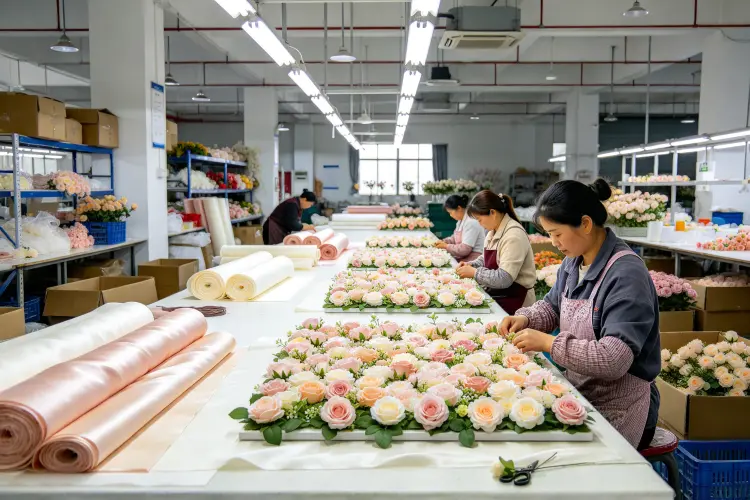
We work directly with our 4,000㎡ factory — no middlemen, no markup. Order in January for May delivery and save 8-12% vs. peak-season pricing. MOQ starts at 10 units for flower walls, 5 units for arches.
Off-Season Maintenance That Saves You Thousands
Here's another secret the top operators know: inventory planning isn't just about buying new stuff. It's about making the stuff you already own last longer. A well-maintained flower wall can last 8-10 years and generate $12,000-$18,000 in rental revenue over its lifetime. A neglected one starts shedding petals after year 3 and looks terrible in photos — which means clients don't rebook and you have to replace it early.
I learned this the hard way. Early in my consulting career, I watched a company in Seattle lose a $50,000 annual corporate contract because their flower walls looked "tired" in the event photos. The client said: "Your walls looked amazing two years ago. Now they look like they've been in a garage." They were right. The walls had been in a garage. No covers, no climate control, just stacked against a wall collecting dust and moisture.
Here's the off-season maintenance routine that top operators follow (January-February, when bookings are slow):
- Inspect every unit: Check for loose petals, broken stems, fabric tears, frame damage. Log every issue in a spreadsheet.
- Deep clean: Use a low-suction vacuum with a brush attachment to remove dust. Wipe frames with mild soap and water. Never use harsh chemicals — they degrade fabric and fade colors.
- Repair or replace: Loose petals? Re-glue with fabric adhesive (not hot glue — it gets brittle). Broken stems? Replace with 18-gauge wire. Fabric tears beyond 2 inches? Retire the panel and reorder.
- Photograph every unit: Take front-facing photos against a white wall. This is your "current condition" record. When a client asks "what does it look like now?" you have proof.
- Store properly: Cover with breathable fabric bags (not plastic — it traps moisture). Store vertically, not stacked horizontally. Keep warehouse humidity below 60%.
- Calculate replacement needs: Any unit with more than 5% petal loss or visible frame damage goes on the reorder list. Place the reorder in January for April delivery.
This 2-week process costs maybe $2,000 in labor and supplies. It extends the life of your inventory by 2-3 years. Do the math: if you have $50,000 in inventory and you extend its life by 2 years, that's $12,500 per year in avoided replacement costs. Not bad for 2 weeks of work in the slow season.

Cash Flow Planning for Seasonal Peaks
Inventory planning and cash flow planning are the same thing wearing different clothes. You can have the best inventory strategy in the world, but if you can't pay for the inventory when the factory wants payment, it doesn't matter.
Here's the cash flow rhythm that works for seasonal rental businesses:
| Month | Cash In | Cash Out | Key Action |
|---|---|---|---|
| Jan – Feb | Low (5-10% of revenue) | Peak inventory purchase (30-40% of annual COGS) | Use holiday-season revenue + deposits to fund purchases. Negotiate 30/70 payment terms with factory (30% deposit, 70% before shipping). |
| Mar – Apr | Building (deposits for May weddings) | Final inventory payments, marketing spend | Collect 50% deposits on all peak-season bookings. This funds your April marketing push. |
| May – Oct | Peak (60-70% of revenue) | Operating costs, minimal inventory | Reserve 25% of peak revenue for holiday inventory orders in July. Don't spend it all on summer expenses. |
| Nov – Dec | Second peak (15-20%) | Holiday inventory already paid for | This is pure profit season — your inventory is already paid for. Bank as much as possible for January purchases. |
The biggest cash flow mistake I see? Spending all your summer revenue on "treating yourself" or expanding the warehouse, then having nothing left for January inventory orders. Then you're stuck financing inventory at 18% APR on a credit card, which eats 3-5% of your margin right there.
Would you rather feel slightly uncomfortable for 10 seconds asking the factory for 30/70 terms, or leave $5,000 on the table in credit card interest? I know which one I'd choose.
5 Costly Mistakes Rental Owners Make
After working with 400+ rental businesses, these are the mistakes I see over and over — and each one costs real money during peak season:
1. Buying based on last year's bookings, not next year's forecast. If you grew 30% last year, your peak inventory needs are 30% higher. Don't buy for last year — buy for next year's projected growth.
2. Ignoring color trends. The #1 requested wall color changes every 2-3 years. In 2023 it was blush pink. In 2025 it was sage green. In 2027, industry data points to warm terracotta and muted mustard. If your inventory is all 2023 colors, you're turning away bookings. Track what clients are asking for, not what you have in stock.
3. No backup inventory for your #1 item. If your most-booked item is the ivory flower wall and you have exactly enough for your busiest weekend, you're one damaged unit away from a crisis. Always have a buffer.
4. Buying from middlemen instead of factories. A US wholesaler might have "immediate shipping" but they're charging you 40-60% more. If you plan 3-6 months ahead, you can buy direct from the factory and save enough to buy 2-3 extra units with the savings.
5. Forgetting that holiday season exists. So many rental owners focus entirely on wedding season (May-Oct) and completely miss the corporate holiday market (Nov-Dec). Corporate holiday events have higher budgets, less price sensitivity, and they book earlier. If you're not prepared for November-December, you're leaving 15-20% of annual revenue on the table.
This last one is the one that makes me want to shake people. I've seen rental companies make $200,000 in wedding season and then barely scrape by in November-December because they "didn't think about corporate events." Meanwhile, the company down the street is doing $50,000 in holiday corporate bookings because they planned for it in July. It's not luck. It's planning.
Frequently Asked Questions
Ready to Plan Your 2027 Peak Season Inventory?
January is the best time to order — lowest prices, shortest lead times, and you'll have inventory in place before the May rush. Our factory direct pricing means you save 40-60% vs. US wholesalers, and our MOQ starts at just 10 units for flower walls.